
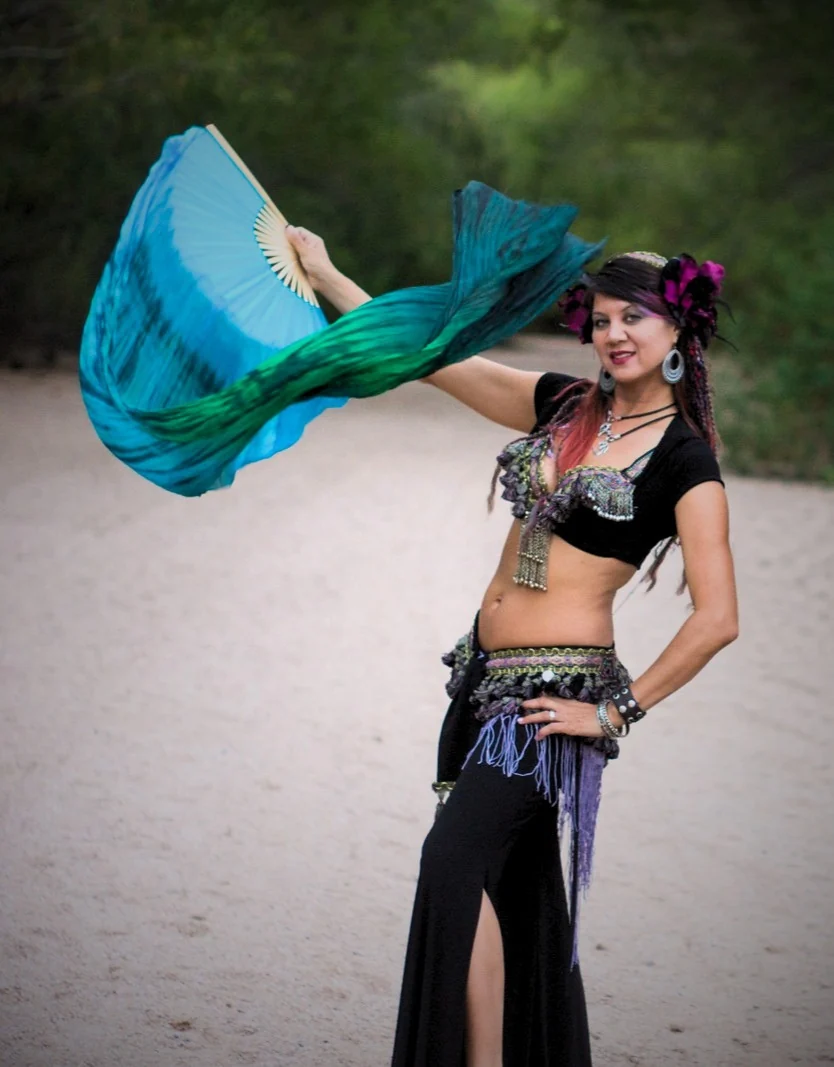
PHOTO INFO
Costume: Domba-inspired costume made by me!
on location at Saguaro Lake (I think?) 2015 by Mort Productions
There is something wonderfully expressive about dancing with a fan. With a flick of the wrist, it can open with a dramatic flourish, frame a movement, conceal a flirtatious smile. Add several feet of silk, and suddenly there are all kinds of new shapes to explore—or enough fabric to swallow you whole while you’re figuring them out.
Like many props used in fusion belly dance, the fan veil does not have one neat little origin story within belly dance itself. Rather, it is a beautiful example of what happens when dancers draw inspiration from different dance traditions, experiment with movement, and create something new.
My own relationship with fans has developed over many years, through different dance influences, performances, workshops, and plenty of experimentation.
Before the Fan Veil
Fans have been used in dance traditions around the world for centuries. They have a particularly long history in Chinese dance, where the fan can become an extension of the dancer’s body—opening, folding, sweeping, fluttering and creating shapes in the air. Chinese classical and folk dance traditions include various forms of fan dancing, while silk and ribbon offer other ways to extend movement beyond the dancer’s hands and arms.
Fans also have a strong visual presence in Spanish dance, including some flamenco-related performances. Sevillanas, a folk dance associated particularly with Seville and Andalusia, traditionally consists of four danced sections, each with its own choreography.
These traditions provide some context for the inspirations dancers bring to fan work, but they do not establish a single, direct path to the modern belly dance fan veil. Asian fan dance, flamenco fan technique, and even burlesque fan dancing all contributed ideas to the rapidly expanding world of belly dance fusion. These worlds eventually found themselves amalgamating with belly dance in some shape or form.
Fans Find Belly Dance
Exactly who first attached a long piece of silk to a fan and brought it onto a belly dance stage is surprisingly difficult to pin down. In my experience, the popularity of fan veils really seemed to bloom in the early 2000s as fusion dancers increasingly experimented with props and influences beyond traditional Raqs Sharqi. By the early 2010s, I was seeing fan veils more frequently on belly dance stages.
One influential dancer in contemporary fan and fan-veil work is Victoria Teel. Through her Teel Fan Method, she developed a distinctive movement vocabulary and a structured approach to working with these props, incorporating influences from Asian dance.
I had the opportunity to hang with Victoria backstage at the Amethyst Dance Festival in 2020, where we were both performing. Unfortunately, I didn’t get to take her workshop—but I did come home with one of her fans.
And naturally, I had to choreograph with it.
From a Shopping Trip to the Competition Stage
My fascination with fans actually began before fan veils became part of my dancing.
When I first began belly dancing as a member of Danah Stedman’s Arizona Belly Dance Troupe in 2002, we often performed folk style dances, commonly called “gypsy” dances at the time—choreographies inspired by Romani dance imagery and movement. We didn’t use fans, but those experiences opened the door for me to look beyond traditional belly dance for inspiration.
One of those inspirations was flamenco.
My interest in Spanish influences grew during a trip to New Mexico in 2003 for the Shake and Bake Belly Dance Festival. I traveled there with Ava Fleming as a member of the Black Opal Dance Company to compete, and our troupe won first place.
Amaya was a vision! Her blend of Spanish and Arabic styling sent my imagination soaring. I came away thinking about what I could explore and share with my dance sisters.
It wasn’t until around 2009 that I created that first fan choreography. My troupe, The Desert Flowers, were preparing for a cultural event with three groups performing hula, belly dance, and folk-inspired dances. In search of flutter fans, we all went to the Chinese Cultural Center in Phoenix and bought “Chinese Olympic fans” in different colors.
Some of the details surrounding that first choreography are a little fuzzy now, but the shopping trip remains a memorable part of the story. Those colorful flutter fans marked the beginning of an exploration that would eventually lead me to fan veils.
That same choreography to “La Casa de Barry” by Hossam Ramzy, eventually made its way to Wiggles of the West in Las Vegas back in 2010. Osiris Dance Ensemble entered their first competition and earned third place. Rather than the long, continuous silk of a fan veil, flutter fans gave us a different visual language—quick bursts, strong shapes and dramatic flashes of fabric.
About a decade later, my fascination was reinvigorated by flamenco dancers performing at a restaurant in the Phoenix area. The passionate skirtwork, powerful stomping, sharp arm movements, and unmistakable attitude reminded me how much expression could live in every gesture.
So I continued exploring.
Spanish Influences on Dialect
My explorations eventually included a choreography using a mid-size fan veil, blending FatChanceBellyDance Style with other dialect movements. Most of those movements came from my mentor, Angie Never in Ohio.
There is an interesting parallel here. Fusion belly dance styles have long drawn inspiration from Spanish dance. FatChanceBellyDance Style, for example, acknowledges influences from Spain alongside Middle Eastern, North African, and Indian dance traditions. Its vocabulary has included a movement called “Egyptian Sevillanas,” credited to Devi Mamak’s Ghawazi Caravan.
Tamarind’s instructional work also includes Spirit of Seville, bringing fan and skirt combinations into the American Tribal Style repertoire. These are different examples of dancers exploring Spanish-inspired movement within fusion belly dance.
Clearly, I wasn’t the only belly dancer looking toward Spain and thinking, I need to work with those fans.
On a visit to Madrid in 2023, I had the opportunity to experience Spanish dance firsthand. I loved the proud carriage, expressive hands, clacking castanets, dramatic turns, and, of course, the fanwork. The attitude and passion were unforgettable.
Most recently, I took a live online fan-veil workshop with Sahira in the Spring of 2025, where I picked up several wonderful new movements and ideas. Even after years of choreographing, I still love those moments when another dancer shows me a possibility I hadn’t considered.
That’s one of my favorite things about props: they keep changing the conversation.
Painting the Air
Moving from flutter fans to fan veils brought a noticeable change. The fabric was more difficult to control, but it also offered more interesting shapes and forms, much like working with a regular veil.
A fan veil can look effortless in skilled hands. Making it look that way is another matter.
The dancer has to think about grip, wrist position, airflow, direction, momentum, timing and where several feet of silk are going to land next. Closing a fan gracefully can sometimes be more challenging than opening it. Changing direction without collapsing the silk takes practice. Add a second fan—or start layering belly dance movement underneath it—and suddenly the pretty floating fabric becomes its own dance partner.
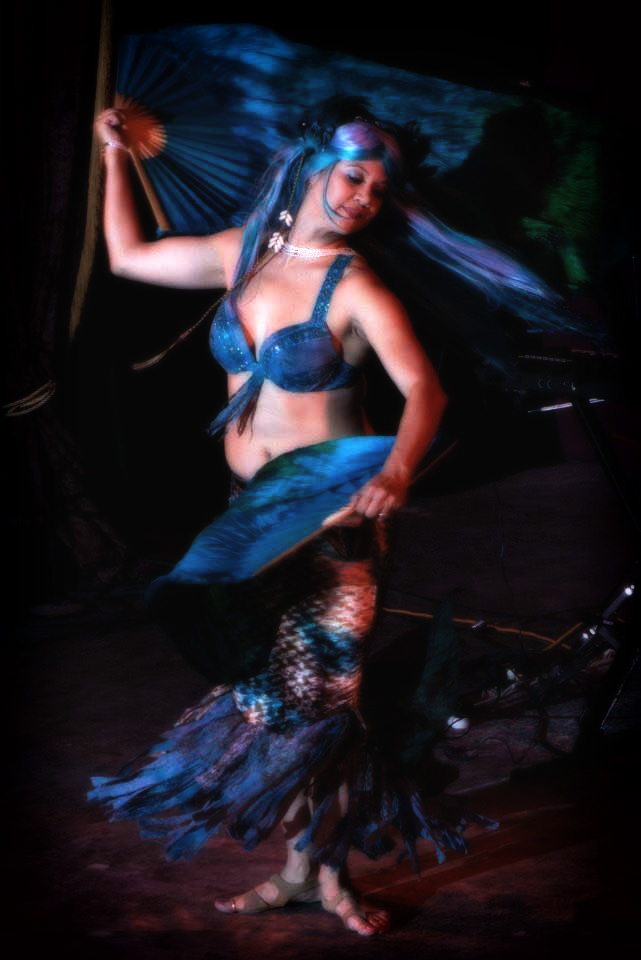
Change the grip or maneuver the fans like poi, and they can feel like an entirely different prop.
That combination of challenge and possibility is what keeps drawing me back. Since my first choreography, I’ve created another fan piece, a couple of fan-veil pieces, and a short fan-veil piece. Each has given me something different to explore.
My experience with fans has never followed just one teacher, one method, or one style. It has grown through watching, learning, experimenting, and returning to the prop with new ideas.
Looking back, I can trace the evolution of my fan-inspired dances through the experiences that shaped them: flamenco performances, shopping for colorful fans with my dance sisters, taking a chance on a competition stage, an unforgettable evening in Madrid, and learning from teachers who continue to show me new possibilities.
A veil extends the movement of the body. A fan creates shape. Put them together, and a dancer can practically paint in the air.
For a fusion belly dancer, that’s a pretty difficult invitation to resist.
Sources & Further Reading
ARC/Naxos, Flamenco Arabe 2. “La Casa de Barry.” Naxos
FatChanceBellyDance, Tribal Basics, Volume 9: Anatomy of a Step, and FCBD University’s Egyptian Sevillana lesson. FatChanceBellyDance
FCBD University, Super Beth biography. courses.fcbdu.com
Goldsmiths, University of London, “Chinese Ribbon and Fan Dance.” Goldsmiths, University of London
International Academy of Middle Eastern Dance (IAMED), Amaya biography
Tablao Flamenco Las Setas–tablaoflamencolassetas.com
Victoria Teel, Official biography. Victoria Teel