

PHOTO INFO
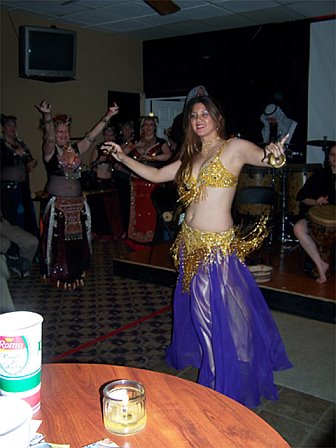
Costume: Madame Abla bedlah
Diosa with Natium Tribal Dance & White Claws World Drumming, 2006
Last month in my Fusion 101 class, my students learned—or revisited—the art of playing finger cymbals. Also known as zills, zils, or sagat, these small metal or wooden percussion instruments are typically worn on the thumb and middle finger of each hand, secured with elastic. These little instruments have a history that reaches well beyond today’s dance styles. Small cymbals have been dated as far back as 30 BCE according to the Metropolitan Museum of Art, who holds small copper-alloy cymbals from Roman-era Egypt. Roman artwork also depicts dancers playing two small cymbals on each hand dating from the 2nd through 4th centuries CE.
Are Zills Important to Belly Dancing?
During our classes, I was asked how important zills are to belly dancing. I’m sure the answer would vary depending on whom you asked!
The closest comparison I can think of is cursive writing. Is it important? Is it necessary? Can something still be worth learning even when we don’t use it every day?
When I first began belly dancing, playing zills was considered an important skill in the dance community I learned from. You weren’t just a dancer; you were also a musician. When performing with a live band, you could contribute to the music rather than simply dance to it.
Later, the bands I danced with often already had someone playing finger cymbals, so it wasn’t always necessary for me to provide that accompaniment. But that didn’t make the skill any less valuable to me.
Beyond adding flair to my performances, playing zills challenged my coordination. Keeping a rhythm going while layering movements of my arms, hips, and chest helped me develop what I think of as “body memory”—getting comfortable enough with one action that I could add another without everything falling apart!
For me, that is part of their value. They offer another way to explore rhythm, challenge ourselves, and participate in the music.
Keeping the rhythm while saving our hearing…
Over the past few years, I’ve been taking FatChanceBellyDance® Style, West Coast, and sword classes with my mentor in Ohio, Angie Never. I often noticed zills being played in FCBD® Style performances, even though we weren’t using them in our classes, so I asked her about the difference.
She explained that zills traditionally accompany the fast movements and brought up concerns about hearing health, particularly with repeated playing and arm positions that bring the cymbals close to the ears.
That conversation raised an important consideration: protecting our hearing is part of caring for ourselves as dancers and musicians. The concern isn’t a particular rhythm, but how loud the sound is and how long and how often we are exposed to it. Loud sounds can damage hearing, and repeated exposure can cause harm over time.
Wooden finger cymbals are one option for quieter practice, producing a more muted, clacking sound instead of the familiar metallic ring. They can be useful for working on patterns and coordination.
However, a quieter instrument is not a guarantee of safe sound levels. Keeping the overall volume down and wearing properly fitted hearing protection in loud settings are important precautions. High-fidelity earplugs are an option designed to reduce volume while preserving more of the sound’s musical quality. Many musicians use them when playing live on stage, so why wouldn’t we as belly dancers?
Revisiting zills with my students reminded me how much challenge, skill, and enjoyment they can add to our dancing. I am grateful that they inquire why we do what we do. Do we need them in every performance? Not necessarily. Do I think they are worth learning and keeping in our repertoire? Absolutely.
We don’t always have to play them—but it’s wonderful to have the choice.
Happy zilling!
Sources & Further Reading
Cottet, Audrey. “Playing Finger Cymbals in the Roman Empire: An Iconographic Study.”
Early Music, Volume 50, Issue 1, February 2022, pp. 3–20. Oxford University Press.
Examines Roman artwork depicting dancers playing two small cymbals on each hand. The article also discusses eighteenth- and nineteenth-century images of dancers using finger cymbals in Egypt, the Ottoman Empire, and Persia. Read the article on Oxford Academic
The Metropolitan Museum of Art. “Cymbal.”
Egypt, Roman Period, 30 BCE–364 CE. Copper alloy.
A surviving small cymbal documenting the presence of these instruments in Roman-period Egypt. The museum record supports the object’s date, origin, and material; it does not, by itself, establish how it was played. View the museum record at The Metropolitan Museum of Art
The Metropolitan Museum of Art. “Zils.”
Turkey, nineteenth century. Brass or bronze.
A surviving set of Turkish finger cymbals supporting the nineteenth-century portion of the historical overview. View the museum record at The Metropolitan Museum of Art
The Metropolitan Museum of Art. “Sagat (Zills).”
Syria, nineteenth century. Brass or bronze.
A surviving Syrian set, catalogued under both sagat and zills, providing another documented nineteenth-century example. View the museum record at The Metropolitan Museum of Art
National Institute on Deafness and Other Communication Disorders. “Hearing Protectors.”
National Institutes of Health. Updated April 16, 2025.
Explains how loud-sound exposure can damage hearing and discusses protective options, including properly fitted earplugs and high-fidelity earplugs that reduce volume while preserving sound quality.