
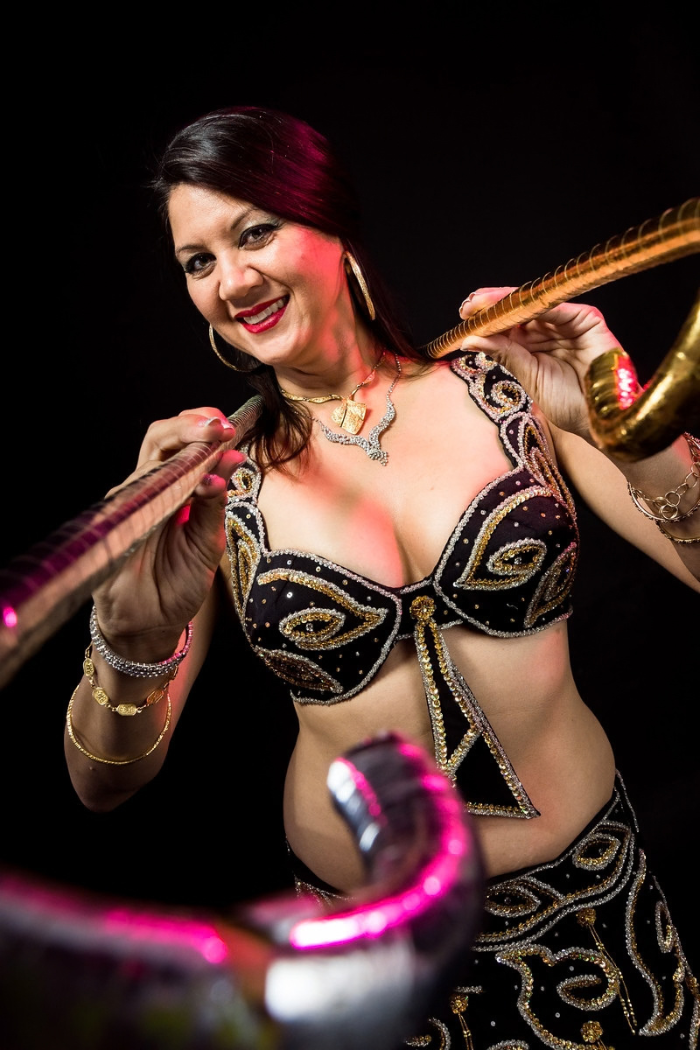
PHOTO INFO
Costume: Madame Abla
Photo credit by Mort Productions, 2017
This month, my Choreo Cram class is learning a new choreography using the assaya. In my early years of learning belly dance, I heard a variety of stories from teachers about how women came to dance with a cane. The story I remember most was that men used the assaya in a traditional martial art, and that women eventually began incorporating the prop into dance, playfully mimicking elements of the men’s style.
I decided I wanted to look more deeply into that story and learn what was historically documented, what evolved through theatrical performance, and what may have become part of belly dance lore over time.
The cane used in Egyptian dance is called an assaya, meaning “stick” or “staff.” Its history is connected to tahtib, a traditional stick-fighting art from Upper Egypt. Tahtib was historically practiced by men and developed from martial training. Over time it also became a festive social tradition demonstrating qualities such as strength, courage, skill, pride, chivalry, and mutual respect.
From this martial tradition developed raqs al-assaya, or “stick dance.” Rather than actually fighting an opponent, a male dancer could use the stick in a solo dance, imitating attacks, defenses, feints, and other movements from tahtib while showing his own personality and skill. Traditionally, the sticks were sturdy, straight, and approximately shoulder height—quite different from the lighter, curved canes often used by belly dancers today.
In the 1960s, Egyptian choreographer Mahmoud Reda and members of the Reda Troupe traveled throughout Egypt studying regional dance traditions. Reda was especially inspired by the stick dancing he observed in Upper Egypt and transformed elements of it for the theatrical stage. His choreography retained much of the movement quality and character of the men’s stick dance while expanding it into staged ensemble productions. Female dancers were also incorporated into these Upper Egyptian-inspired choreographies, although Farida Fahmy notes that the women of the Reda Troupe originally did not carry sticks themselves.
“Over time, the cane also became a popular prop in women’s Egyptian and belly dance performances. Modern female cane dancing often takes on a more playful and theatrical character, incorporating flirtation, humor, sassiness, balancing, and twirling.”
Today, dancing with a cane can acknowledge its roots in the strength and pride of Upper Egyptian stick traditions while also allowing the dancer to create an entirely different character.
In our choreography, we are not trying to recreate the traditionally masculine fighting style of tahtib. Instead, we are exploring the cane as an extension of the dancer’s body and as a partner in the dance. It helps shape our lines, direct our focus, frame our movements, and add personality to the choreography. Our character is vaudeville-inspired: flirty, sassy, mischievous, and cheeky. We can swagger with the cane, tease with it, twirl it, pose with it, lean into it, and respond to it almost as if it were another performer sharing the stage with us.
So while the assaya carries a history of strength, skill, and tradition, in our choreography it also becomes a way to express character, musicality, humor, and connection. The cane is not simply something we carry. It becomes part of how we move.
Sources & Further Reading
UNESCO Intangible Cultural Heritage.
“Tahteeb, Stick Game.” Inscribed on the Representative List of the Intangible Cultural Heritage of Humanity, 2016.
An excellent primary reference for the history and cultural meaning of tahtib, the Upper Egyptian stick-fighting tradition. UNESCO describes its martial origins and its associations with courage, strength, chivalry, pride, friendship, and mutual respect.
https://ich.unesco.org/en/RL/tahteeb-stick-game-01189
Fahmy, Farida.
“The Artistic Impact of the Reda Troupe: New Choreographies of Indigenous Dances.”
Part of Farida Fahmy’s series documenting the work and influence of Mahmoud Reda and the Reda Troupe. Fahmy discusses al-ʿAsaya, the traditional male stick dance, Mahmoud Reda’s study and adaptation of Egyptian regional dance traditions, and the development of stick dance for the theatrical stage.
https://faridafahmy.com/pdfs/FaridaFahmyArticle7ENGLISH.pdf
Fahmy, Farida.
“The Artistic Impact of the Reda Troupe” series.
Farida Fahmy was a principal dancer and co-founder of the Reda Troupe and later studied dance ethnology at UCLA. Her writings are especially valuable because they combine firsthand experience with later scholarly analysis of how regional Egyptian dances were adapted for the stage.
https://www.faridafahmy.com/RedaSeries.html
Deagon, Andrea.
“In Search of the Origins of Dance: Real History or Fragments of Ourselves?” Habibi, Vol. 17, No. 1, Spring 1998, pp. 20–21, 35–36.
A useful discussion of the difficulty of separating documented Middle Eastern dance history from the colorful “origin stories” that have circulated within the belly dance community. This is particularly helpful when discussing claims about women parodying men with canes or the symbolic origins of sword dancing.
https://www.shira.net/about/origins-deagon.htm
A Note About Terminology
Assaya / ʿAsaya means “stick” or “staff.”
Raqs al-Assaya means “stick dance.”
Tahtib / Tahteeb refers to the traditional Egyptian stick-fighting practice from which related dance forms developed.
Spellings vary because Arabic words can be transliterated into English in several ways. You may see assaya, asaya, ʿasayah, tahtib, or tahteeb referring to the same or closely related terms.
I’m excited you teach cane! I learned cane for the first time at the Mesa Arts Center, it always makes me happy to watch other dancers using assaya.
I don’t get to use cane too often (unless it’s an open prop moment for my troupe. Though last time I performed with my canes at a gig, one did go flying. No injuries… it was played off as a gag).
I’m also very excited to find your blog and learn you lean towards Vaudevillian inspiration, it’s also one of my favorite eras and I too like to draw inspiration from there when I perform.